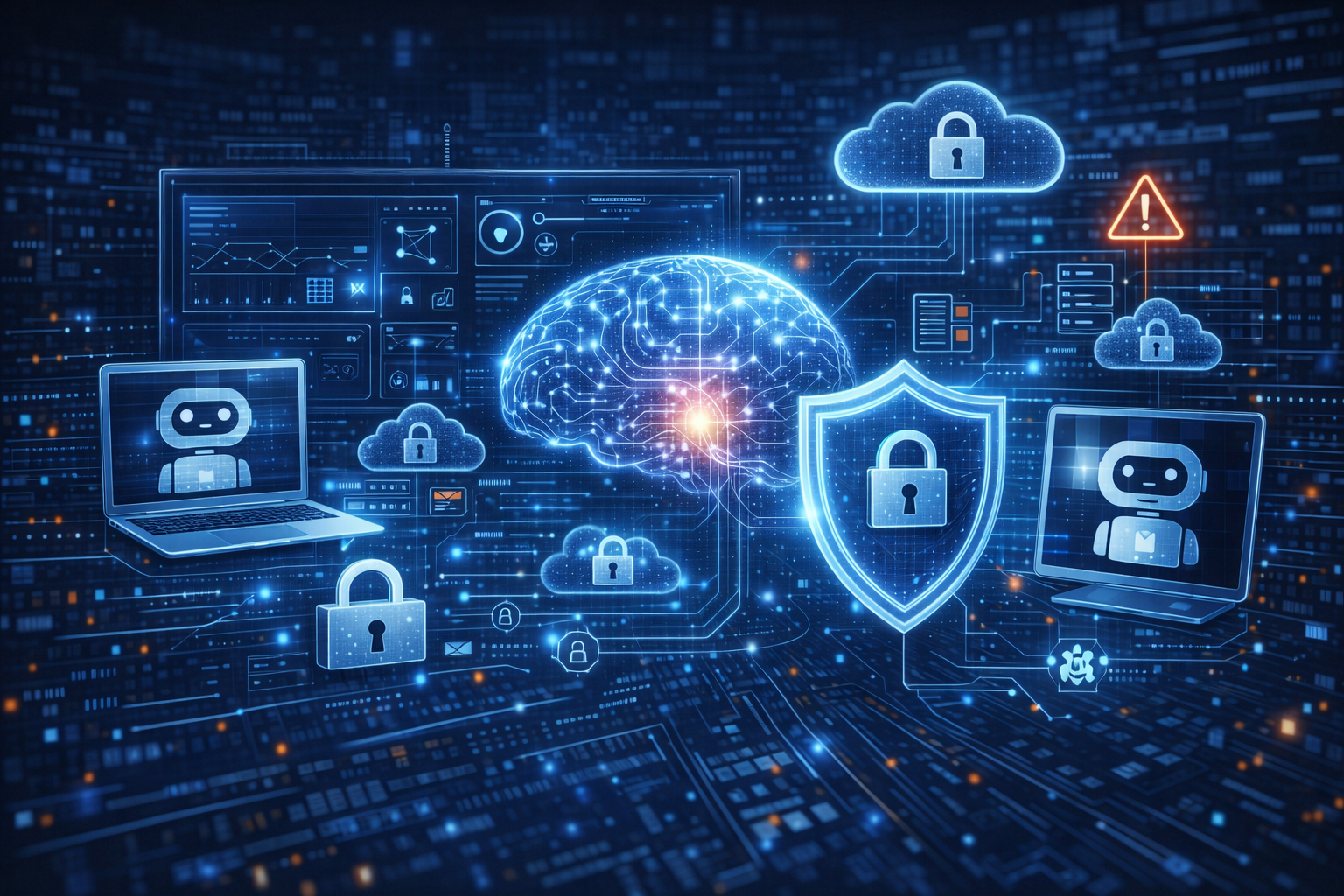
AI apps, copilots, and autonomous AI agents are becoming part of everyday business operations. They can improve productivity, automate workflows, and support decision-making, but they also introduce new security risks. From prompt injection and data leakage to insecure integrations and weak governance, businesses need to secure AI systems before those risks become real incidents.
Introduction
Artificial intelligence is changing how businesses work. AI chatbots, coding copilots, workflow assistants, and autonomous AI agents are now being used across customer service, operations, development, and internal productivity. While these tools offer speed and efficiency, they also create a new attack surface.
Unlike traditional software, AI systems often interact with natural language, third-party tools, private data, and external APIs. That means security teams must think beyond normal application security. Businesses need to protect AI systems from prompt-based abuse, unauthorized data exposure, insecure integrations, and poor oversight.
1. Prompt Injection Is a Real Security Risk
One of the biggest threats in AI security is prompt injection. This happens when an attacker manipulates an AI system through crafted inputs so that it ignores its intended instructions or reveals sensitive information.
For example, an attacker may try to make an AI assistant expose hidden prompts, bypass controls, or perform actions it should not perform. If the AI app has access to tools, plugins, or internal systems, the impact can become much bigger.
Why it matters:
If not controlled properly, prompt injection can lead to data exposure, unsafe outputs, or unauthorized actions.
2. Data Leakage Must Be Prevented
AI systems often process confidential information such as internal documents, customer records, business plans, support tickets, and source code. If this data is not handled properly, it can be leaked through prompts, outputs, logs, or connected systems.
Businesses must be especially careful when employees use AI tools with sensitive data without clear policies or technical safeguards.
Why it matters:
Even a helpful AI assistant can become a data exposure risk if it is connected to sensitive content without proper restrictions.
3. Insecure Integrations Can Expand the Attack Surface
Many AI apps and copilots connect to cloud storage, CRM platforms, email systems, ticketing tools, internal databases, third-party APIs, and browser tools. These integrations make AI more powerful, but they also increase risk.
If an AI assistant has broad access to multiple systems, a single weakness could affect far more than one application.
Why it matters:
Poorly secured integrations can turn a limited AI issue into a larger business security incident.
4. Over-Permissioned AI Agents Are Dangerous
AI agents are designed to take actions, not just provide answers. Some can send emails, update records, run workflows, generate code, or access internal tools. If these agents are given too many permissions, they can become highly risky.
An AI agent should never have more access than it truly needs. Businesses should apply the principle of least privilege and make sure high-risk actions require validation or approval.
Why it matters:
The more autonomy an AI agent has, the more important access control and monitoring become.
5. Governance Is Just as Important as Technology
AI security is not only about technical controls. It also depends on governance, policy, and accountability. Businesses need to know what AI tools are being used, what data those tools can access, who is responsible for oversight, what rules employees must follow, how outputs are reviewed, and how incidents will be handled.
Without governance, even secure AI tools can be misused.
Why it matters:
A strong governance model helps businesses use AI safely, consistently, and responsibly.
6. Logging, Monitoring, and Human Oversight Matter
AI systems should not operate like invisible black boxes. Businesses should log important events, monitor abnormal behavior, and review high-risk actions. Sensitive workflows should include human approval steps, especially when agents can affect customers, finances, security settings, or business-critical systems.
Why it matters:
Monitoring and human oversight reduce the chance that AI misuse or abnormal behavior goes unnoticed.
Best Practices to Secure AI Apps, Copilots, and Agents
- Restrict access to sensitive data
- Apply least privilege to AI tools and agents
- Validate prompts, outputs, and tool calls
- Review and secure third-party integrations
- Segment systems where possible
- Log AI activity and monitor unusual behavior
- Require human approval for high-risk actions
- Create clear AI usage policies
- Train staff on safe AI use
- Regularly test AI workflows for abuse cases
Conclusion
AI apps, copilots, and AI agents can bring major business value, but they also introduce new and complex security challenges. Prompt injection, data leakage, insecure integrations, excessive permissions, and weak governance can quickly turn useful AI systems into business risks. The right approach is not to avoid AI, but to secure it properly from the beginning with strong controls, clear oversight, and continuous monitoring.