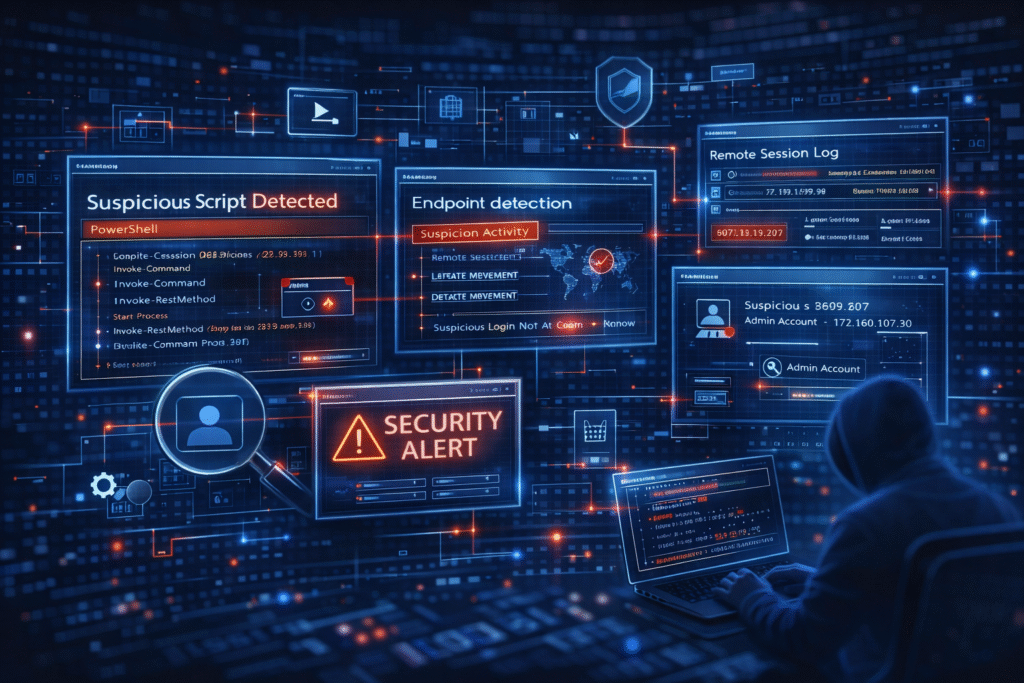
Not every cyberattack starts with a suspicious file or obvious malware. Today, many attackers are using legitimate tools already present in business environments to move silently, steal data, and maintain access. This makes malware-free attacks especially dangerous because they often blend in with normal activity and are harder to detect with traditional security methods.
Introduction
Cybersecurity teams have long focused on detecting malicious files, harmful downloads, and known malware signatures. But attackers are changing their methods. Instead of always deploying custom malware, many now rely on trusted system tools, remote administration utilities, scripting environments, and built-in operating system features to carry out attacks.
These are often called malware-free attacks or living-off-the-land attacks. They are dangerous because they use tools that businesses already trust. As a result, suspicious activity can look like legitimate administration, normal automation, or routine system management.
1. What Are Malware-Free Attacks?
Malware-free attacks are intrusions where attackers use legitimate software, built-in system tools, or approved utilities to perform malicious actions without relying heavily on traditional malware.
- PowerShell
- Remote desktop tools
- Command-line utilities
- Windows administration tools
- Scripting engines
- Credential abuse through trusted processes
- Cloud admin interfaces and valid accounts
Because these tools are real and often necessary for daily operations, they do not always trigger basic antivirus or signature-based defenses.
2. Why Legitimate Tools Make These Attacks More Dangerous
Traditional security controls are often designed to look for known bad files or clearly malicious code. But when attackers use trusted tools, they hide within normal business activity.
A remote support tool may look like standard IT access. A PowerShell script may appear to be routine automation. A cloud login may seem like a legitimate user session.
Why it matters:
The attack may not look malicious at first, but the impact can still include data theft, lateral movement, privilege escalation, and ransomware deployment.
3. Why Attackers Prefer This Approach
Attackers like malware-free techniques because they are quieter, harder to detect, cheaper to execute, less dependent on custom code, and more effective in environments with strong malware defenses.
4. Common Examples of Malware-Free Activity
Some common attack behaviors include:
- using PowerShell to download or run commands
- abusing remote management tools
- using compromised credentials to access systems
- creating scheduled tasks for persistence
- moving laterally through remote desktop or admin tools
- accessing cloud platforms with stolen accounts
- collecting and exfiltrating data through trusted utilities
The problem is not the tool itself. The problem is how and why it is being used.
5. Why Businesses Struggle to Detect It
Many businesses still depend too heavily on signature-based security. That works for known malware, but not always for suspicious behavior using normal tools.
Security teams may also face too many alerts, limited visibility into endpoint behavior, poor identity monitoring, weak logging of scripts and admin actions, and lack of baselines for normal tool usage.
6. Identity and Access Are Part of the Problem
Malware-free attacks often rely on valid credentials. If attackers can steal usernames, passwords, tokens, or session data, they may not need malware at all. They can simply log in and act like a normal user or administrator.
Why it matters:
If a real account is being abused, the activity may initially look completely legitimate.
7. How Businesses Can Defend Against Malware-Free Attacks
- monitor PowerShell, scripts, and command-line activity
- apply least privilege to accounts and tools
- restrict unnecessary admin utilities
- log remote access and privileged sessions
- enforce MFA across critical systems
- detect unusual account behavior
- monitor lateral movement patterns
- segment internal systems
- review use of remote management tools
- build strong incident detection and response workflows
Conclusion
Malware-free attacks are becoming more dangerous because they exploit trust. By abusing legitimate tools, attackers can blend into normal activity and avoid traditional defenses. Businesses that rely only on malware detection are likely to miss these quieter, more evasive techniques. The better approach is to combine identity security, behavioral monitoring, access control, and strong visibility across endpoints, users, and cloud systems.